Today, some students of the IES Francisco Montoya, from Las Norias (Almería) have constructed the 2nd iteration of the Menger sponge, with the help of their math teacher Lidia García. They have used 1056 squares, 176 squares per 6 colours, one for each face. They have spent about 3 hours to complete it. Really cool and funny!
This project, started with David Crespo as explained in this post, will be presented at the XII Feria de la Ciencia de Sevilla together with many other manipulative games with fractals.
You can see it these days in the hall of the school center!
How many squares do we need to build the 1st iteration of a Menger sponge? Children can easily count this, if they chose 6 different colors to make it, such that all squares looking at the same face have the same color. In the picture below, we see for instance that the yelow exterior face has 8 squares, and we have 4 more yelow squares in the interior. This gives12 squares per color, so times 6 gives 72 squares. For the second iteration we would need 1056 squares!! We will try to make it soon. If you are interested on a mathematical formula for this and the nth-iteration of the Menger sponge, please visit our blog Juegos Topológicos.
Here, we have pushed the corners to make this nice version with octogonal faces. The flexibility of this material allows to make new figures and shapes.
Mathematics is always fun with 3D Polyfelt, but children also like to play and make its own figures and constructions!
And you can make your own house to play with your dolls!
David Crespo with a Soma cube.
Lidia García making a kind of "dodecahedron" with 60 squares.
3DPolyfelt was presented at the FAMILY DAY & MATH-ART EXPO, on July 28th, 2013, in Enshede. This is a public activity of the international congress BRIDGES 2013. (Updated July 30th) We have made the omnitruncation of the fullerene C60! We were glad to see how the ZOME team made the supermolecule C60xC60.
Recall that the fullerene C60 - the standard buckyball or truncated icosahedron- has 60 vertices, 90 edges, 12 pentagons, and 20 hexagons. The omnitruncation operation consists of cutting the vertices and edges at the same time. The omnitruncation of C60 has then 182 faces: 60 hexagons, 90 squares, 12 decagons, and 20 dodecagons. As each polygon has 10 cm side, the diameter of the balloon which supports the figure will be about 133 cm in diameter. To calculate this diameter we sum the areas of regular polygons 182, equate to the surface of the sphere 4 Pi r ^ 2, and solve for the radius r. Here is the formula programmed in Mathematica L = 10; AreaPoliedron = N[90*4 L^2 /(4 Tan[Pi/4]) + 60*6 L^2 /(4 Tan[Pi/6]) + 12*10 L^2 /(4 Tan[Pi/10]) + 20*12 L^2 /(4 Tan[Pi/12])]; DiameterBalloon = 2 Sqrt[Area/(4 Pi)]).
In our session, our colleague Vi Hart could solve the Menger sponge puzzle in a few minutes! At the end of the video, the artist Rinus Roelofs looks the result.
Scherk surface model with 3D Polyfelt, fixed on a ZOME cube.
As announced in "Covering a float with 3DPolyfelt" we have continued working on tessellations of surfaces with our flexible pieces of felt. There are many figures left, but here are some surfaces.
Session 1: (May 16th, 2013)
We have "covered" several surfaces with regular polygons: cylinders, cones, toruses and some hyperbolic surfaces, like the Scherk surface. It has been a very interesting experience, that we would like to share with other Math teachers of primary and secondary schools. More advanced sessions for high schools or university level can be also done, as we will see below.
Students can recognize immediately different types of curvatures depending on the configuration of polygons around each point. One can see that around a FLAT point, the sum of the angles is exactly 360º. Around a PARABOLIC point, like in any convex polyhedron, the sum has to be <360º. And around a HYPERBOLIC point the sum must be > 360º. The difference from 360º is called defect (or excess) of the vertice (see example below, added on May 22nd).
The next step could be to find all possibe combinations for each of these three types of points. This would lead, for instance, to the classification of semiregular mosaics, or the Archimedian polyhedra. The concepts of Gauss and mean curvatures could be also introduced, if one has soap bubbles, like in our case. [Added on May 22nd: We thank David Crespo tell us his experience with semiregular mosaics at his school.]
Another interesting concept is the Euler characteristic (X= vertices-edges+faces) of the constructed tessellations. Here the teacher explains that the Euler characteristic of the platonic solids is 2, and other simple examples. In general, one can check if the formulas X=2-2g-r (respectively, X=2-g-r) if the surfaces are orientable (respectively, non orientable), where g is the genus of the surface and r is the number of boundary components.
Session 2: (May 21st, 2913)
We have continued working on the torus, since this was not successfull in the previous session. This time, my students of Differential geometry of Curves and Surfaces, of 3rd year of Mathematics have got tessellations for two floats of different sizes. And you can see the result in this video!
Session 3: (May 22nd, 2013)
As we know, the torus is an orientable surface of genus g=1, without boundary (r=0), hence its Euler characteristic is X=2-2g-r=0. This can also be computed with any tessellation. By a carefully counting, our tessellation of the small float has 27 vertices, 113 edges, and 86 triangles. This gives X= 27-113+86=0.
We can also apply the discrete Gauss-Bonet theorem (a generalization of Descartes's theorem) to get the Euler characteristic of the torus (times 2 Pi), which is 0. For that we have to compute the angular defect / excess of all the vertices. Recall that the angular defect (if possitive, or excess, if negative) of a vertice is equal to 2 Pi minus the sum of the angles of the polygons around.
In our particular tessellation of the small float, we have
11 flat vertices, i.e. with 6 (equilateral) triangles around. The defect of such vertices is 2 Pi - 6 (Pi/3) =0, so these do not count.
9 parabolic vertices, with 5 triangles around. The excess of each vertice is 2 Pi - 5 (Pi/3)= Pi/3, hence the total defect is 9 Pi/3.
7 hyperbolic points, 2 of 8 triangles, and 5 of 7 triangles. Each vertice of 8 triangles gives an excess of 2 Pi -8 (Pi/3) = -2 Pi/3. Each vertice of 7 triangles, 2 Pi - 7(Pi/3) = - Pi/3. The sum of all excesses is -9 Pi/3.
Hence, the sum of all excesses and defects is 0, as desired.
We have seen two different easy ways to compute the Euler characteristic of a surface.
Excercise: Can you do the same for our tessellation of the big float? You can also try with the Stewart torus.
Participants of these sessions: Isabel María Romero ( Departamento de Didáctica, de la Universidad de Almería), David Crespo (del colegio Agave, de Huercal de Almería)
and myself,
Students of the subject "La geometría y la medida en educación primaria", of the Grado en Educación Primaria, of the University of Almería.
Students of high school Agave, Almería
Students of 3th degree of Mathematics.
PD: Esta entrada participa en la Edición 4.1231 del Carnaval de Matemáticas, cuyo blog anfitrión es i-matematicas.
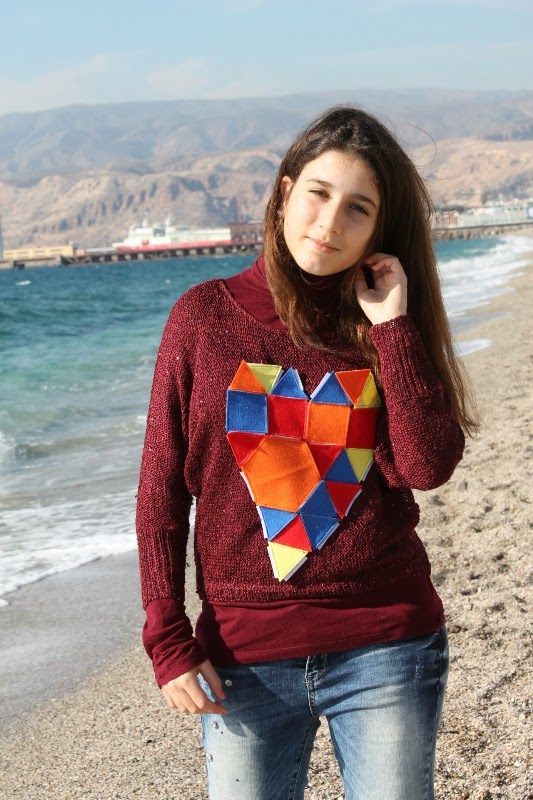
3D Polyfelt ables you to design geometric fashion dresses, accessories, etc! Very easy and fast! Look at this bag made with diamonds from the Deltahedra set.
Do you have other ideas? We will publish them in our FASHION AND DESIGN page.
Polifieltros 3D se exhibió, entre otros juegos geométricos del Mago Moebius, durante la Semana de la Ciencia en la UAL, celebrada del 5 al 9 de noviembre de 2012. Alumnas y alumnos de distintos institutos de la provincia pudieron montar mosaicos y poliedros como los que véis en estas fotos.