3D Polyfelts and Neotrie VR have been recently used in the Master's degree in Secondary Education Teaching of the University of Almería to design new and combined activities about polyhedra, tillings and fractals. Want to know more?
El verano está para divertirse, y que mejor que hacerlo ¡jugando con Polifieltros 3D! Si además lo combinamos con Neotrie, el nuevo software de Realidad Virtual, que está desarrollando Virtual Dor, la Geometría toma una nueva dimensión, jamás experimentada hasta ahora.
Esta nueva experiencia es la que han vivido los chavales del Club Náutico de Aguadulce, en unas jornadas organizadas por Juega Conmigo Talleres, durante esta semana del 24 al 27 de octubre de 2017.
Vídeo realizado por alumnos del IES Itaca (Tomares, Sevilla)sobre el taller del 15 de marzo de 2017. Gracias a Diego Cangas, Antonio Zarauz, por acompañarme en este fantástico viaje a "Itaca".
Today, some students of the IES Francisco Montoya, from Las Norias (Almería) have constructed the 2nd iteration of the Menger sponge, with the help of their math teacher Lidia García. They have used 1056 squares, 176 squares per 6 colours, one for each face. They have spent about 3 hours to complete it. Really cool and funny!
This project, started with David Crespo as explained in this post, will be presented at the XII Feria de la Ciencia de Sevilla together with many other manipulative games with fractals.
You can see it these days in the hall of the school center!
How many squares do we need to build the 1st iteration of a Menger sponge? Children can easily count this, if they chose 6 different colors to make it, such that all squares looking at the same face have the same color. In the picture below, we see for instance that the yelow exterior face has 8 squares, and we have 4 more yelow squares in the interior. This gives12 squares per color, so times 6 gives 72 squares. For the second iteration we would need 1056 squares!! We will try to make it soon. If you are interested on a mathematical formula for this and the nth-iteration of the Menger sponge, please visit our blog Juegos Topológicos.
Here, we have pushed the corners to make this nice version with octogonal faces. The flexibility of this material allows to make new figures and shapes.
Mathematics is always fun with 3D Polyfelt, but children also like to play and make its own figures and constructions!
And you can make your own house to play with your dolls!
David Crespo with a Soma cube.
Lidia García making a kind of "dodecahedron" with 60 squares.
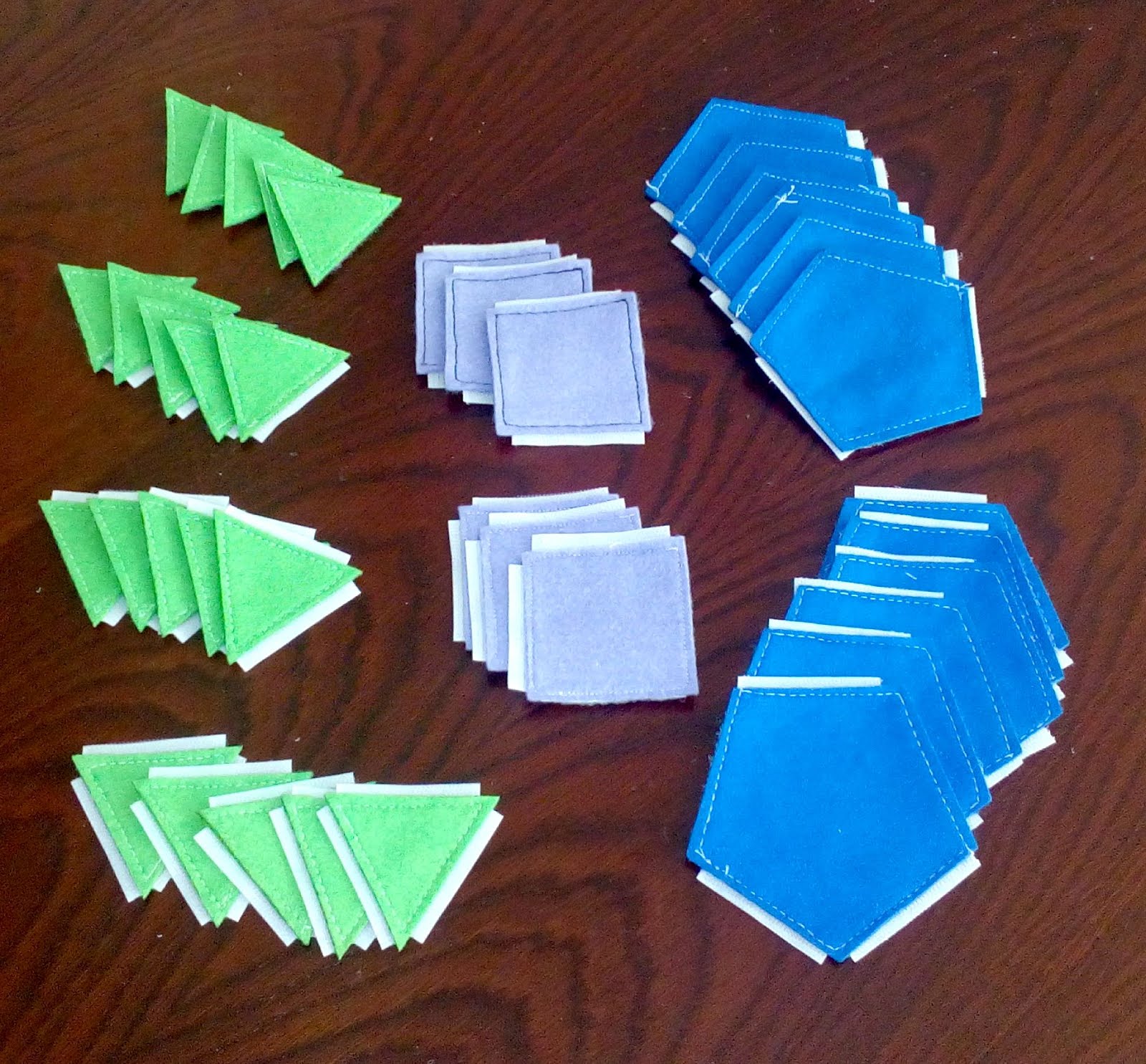
You can already get the new kit of 60 isosceles triangles to design and mount easily your own geometric lamps, and many other figures!
NUEVAS LÁMPARAS CON POLIFIELTROS 3D: Ya puedes conseguir un nuevo kit de 60 triángulos isósceles con el que podrás diseñar y montar fácilmente tu propia lámpara geométrica y muchas figuras más!
Dodecaedro estrellado pequeño. Small stellated dodecahedron (see the 3 stellated dodecahedra).
David Crespo y Lidia García, colaboradores de Polifieltros 3D montando una estrella octángula.
3DPolyfelt was presented at the FAMILY DAY & MATH-ART EXPO, on July 28th, 2013, in Enshede. This is a public activity of the international congress BRIDGES 2013. (Updated July 30th) We have made the omnitruncation of the fullerene C60! We were glad to see how the ZOME team made the supermolecule C60xC60.
Recall that the fullerene C60 - the standard buckyball or truncated icosahedron- has 60 vertices, 90 edges, 12 pentagons, and 20 hexagons. The omnitruncation operation consists of cutting the vertices and edges at the same time. The omnitruncation of C60 has then 182 faces: 60 hexagons, 90 squares, 12 decagons, and 20 dodecagons. As each polygon has 10 cm side, the diameter of the balloon which supports the figure will be about 133 cm in diameter. To calculate this diameter we sum the areas of regular polygons 182, equate to the surface of the sphere 4 Pi r ^ 2, and solve for the radius r. Here is the formula programmed in Mathematica L = 10; AreaPoliedron = N[90*4 L^2 /(4 Tan[Pi/4]) + 60*6 L^2 /(4 Tan[Pi/6]) + 12*10 L^2 /(4 Tan[Pi/10]) + 20*12 L^2 /(4 Tan[Pi/12])]; DiameterBalloon = 2 Sqrt[Area/(4 Pi)]).
In our session, our colleague Vi Hart could solve the Menger sponge puzzle in a few minutes! At the end of the video, the artist Rinus Roelofs looks the result.